A Council Letter to the Wrong Address Costs About a Pound. The Question Is How Many Times the Same Mistake Gets Made.
Estimated reading time: 7 minutes
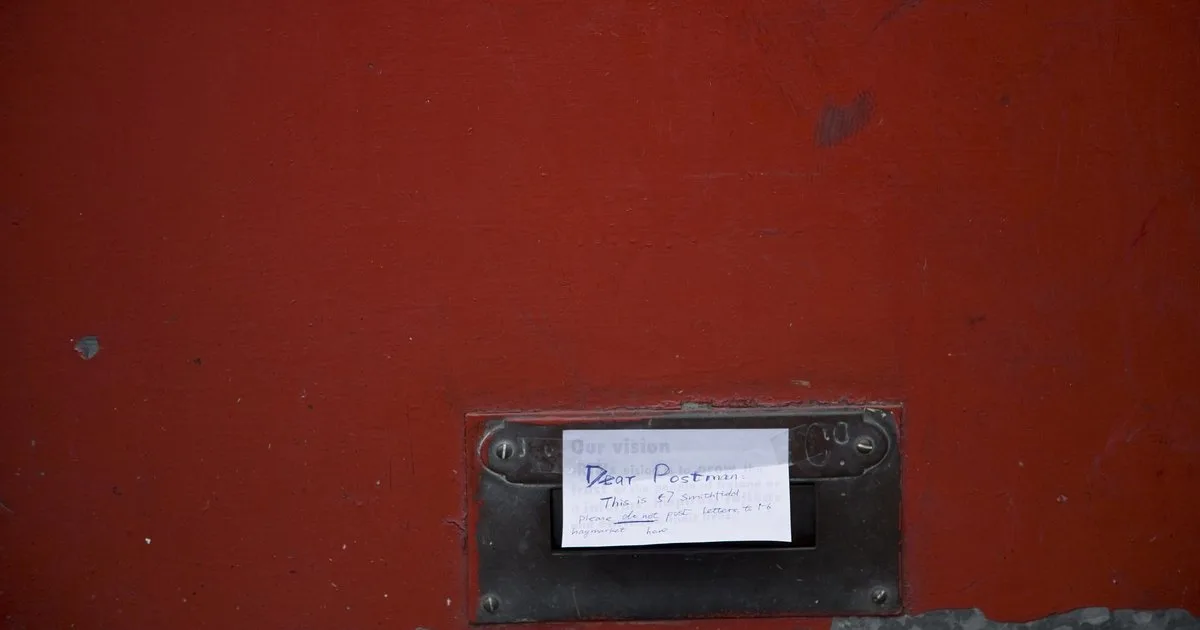

In short. A wrongly addressed, duplicated or unnecessary council letter looks trivial: one envelope, one sheet, one second class stamp. Royal Mail's business price guide, current from 13 May 2026, prices a second class letter on a business account at 91p, or 88p on the guide's other account tariff [1]. Add paper, printing, envelope and handling and a pound an item is a fair working figure. Sent once it is nothing. Sent to the wrong person, sent twice, or sent to ten thousand people after a defect nobody caught, the same letter becomes a cost that public money paid and no line in the accounts will ever show. The records that would put a figure on it exist, and this piece ends with the request that asks for them.
This piece starts with an envelope on my own doormat. A property I own received a letter from Wiltshire Council addressed to a former tenant. It was not the first. Several weeks earlier I had told the council that nobody of that name lived at the address. The letter came anyway. That is the whole of what I know, and I have not put questions to Wiltshire Council about it, so nothing that follows is a finding about that council. What the second envelope did was prompt a more general question: what does a letter like that cost, and what would a council have to show to account for it?
What one letter costs
A council letter is a small thing. It arrives, it is opened or it is not, and it joins the pile. But it is not free because it is ordinary.
Royal Mail's Business Price Guide, valid from 13 May 2026, gives the account price for a second class letter up to 100 grams as 91p on one account tariff and 88p on the other, and says these account services are exempt from VAT [1]. A letter, for these purposes, is at most 240 millimetres by 165 millimetres, no more than 5 millimetres thick and no more than 100 grams, which a folded A4 sheet in a standard envelope meets comfortably [1]. Second class, the guide says, aims for delivery within two to three working days [1].
That is postage alone. There is also the paper, the printing, the envelope, the data preparation, the folding and inserting, the address cleansing, the production management, and the staff time spent on whatever comes back. Councils that send large volumes can buy sorted mail more cheaply: Royal Mail's separate retail letters guide, current from August 2026, prices a second class Business Mail letter sorted and barcoded by the sender at 82.6p an item for a daily posting of 4,000 or more, falling to 78.9p at 80,000 or more [8]. Councils that use an external print and post supplier pay that supplier's rate instead.
The working figure. For a routine one page printed notice, an all-in cost of about a pound per item is a reasonable estimate: 91p of postage at the account rate [1], plus a modest allowance for paper, printing, envelope and handling. It will be lower in a large, well run sorted batch. It will be higher where a supplier is involved, where the letter runs to several pages, or where returned post has to be dealt with. The exact figure for any particular council is in its contract, its invoices and its mailing records, not in this piece. The point is not that every envelope has one fixed price. It is that a repeated administrative mistake has a price at all.
The arithmetic is simple
At 91p, postage alone for one thousand second class letters is 910 pounds before a single sheet is printed. At ten thousand it is 9,100 pounds.
Add a cautious 15p for a monochrome printed sheet, an envelope and handling, and the indicative figure is about 1.06 pounds an item:
| Letters sent in error | Illustrative cost at 1.06 pounds each |
|---|---|
| 100 | 106 pounds |
| 1,000 | 1,060 pounds |
| 5,000 | 5,300 pounds |
| 10,000 | 10,600 pounds |
| 50,000 | 53,000 pounds |
These are not claims about any authority's spending. They are illustrations of scale. An actual investigation would separate postage from printing, internal labour from external fulfilment contracts, and would note the VAT treatment of each service bought.
Even so, a cautious estimate changes the character of the question. "Why did I get this twice?" is not only an irritation. It may be a question about whether the authority's records, its approval process and its controls worked before public money was spent.
A letter is evidence of a process
A mistaken mailing can happen for innocent reasons. A change of address may not have reached every system a council runs. A supplier may have used an old data extract. A mailing list may have been generated before a duplicate was removed. A team may have sent a corrective notice because an earlier one was wrong.
Those explanations matter. So does the difference between a one-off and a recurring failure, and the questions that separate the two are ordinary ones:
- What triggered the mailing, and who approved it?
- How many items were sent?
- What did postage, print and fulfilment cost?
- Was the error found before or after despatch?
- Did the council send a second mailing to correct the first?
- How many items came back undeliverable?
- Does the authority measure duplicate, returned or wrongly addressed mail at all?
- Was the mailing produced in-house or under an external contract?
- What changed afterwards to stop it happening again?
A council should be able to answer most of these from routine records. There will be a purchase order or an invoice. There may be a print room job sheet, a supplier's fulfilment report, a mailing list extract, approval emails, contract management notes and a returned mail log. Where personal data is involved, what can be published is limited. That does not prevent disclosure of aggregate numbers, costs, dates, decision records and the corrective action taken.
Small errors become systems failures
The loss from one wrongly sent letter is minor. The serious cost appears when the same weakness reaches a mass mailing. Three patterns recur:
- The duplicate notice. A resident gets two copies because the same person exists twice in a customer record or the electoral register. The immediate cost is two letters instead of one. The wider question is whether the council has a control that finds duplicates before the mailing file is generated.
- The wrong template. A whole batch goes out with the wrong date, the wrong contact details or the wrong instruction, and a correction follows. The original mailing, the corrective mailing and the staff time are all avoidable. Some residents will have acted on the first letter before the second arrives.
- The wrong audience. A mailing list includes people who should not have received the letter at all. The cost is not only print and postage that bought nothing. It may create a data protection problem, generate calls and complaints, and reduce confidence in the service.
The cost of a mistake is therefore not confined to the envelope. It includes contact centre calls, complaint handling, officer time, the correction itself, and in some cases the cost of reviewing whether personal information was used or disclosed properly.
Could the council just have checked with the DWP?
The obvious retort to my own envelope is that government already holds a very good address database. The Department for Work and Pensions runs the Customer Information System, which the department describes as storing basic identifying information about a person: name, address, date of birth and National Insurance number, including a history of previous addresses [5]. Councils have access to it. Why not use it to keep every address current?
Because the access is purpose-limited, and the purposes do not include general correspondence. The DWP's own bulletin to council housing benefit staff states that local authority access to the system, through the Employee Authentication Service, is permitted only for administering Housing Benefit, Local Council Tax Reduction, Local Welfare Provision, Adult Social Care financial assessments and Discretionary Housing Payments, and that the system cannot be used for any unauthorised purpose [4]. The same bulletin says that the DWP and HMRC interrogate the system to check that council staff accesses are for genuine business needs, that management "test checks" are compulsory, that anyone found abusing it may face sanctions from disciplinary action to prosecution, and that access can be withdrawn from a council as a whole [4].
The DWP's data sharing guide for local authorities puts the underlying rule the same way: to access the system directly a council needs a legal gateway, the access it gets is read only, the data is supplied for the limited purposes of Housing Benefit, local council tax reduction schemes and local welfare provision, and councils must not access it for any other welfare service purpose [6].
What that means in practice. A benefits officer may consult the DWP system while deciding a Housing Benefit or Council Tax Reduction case, because that is what the access is for [4]. A council tax collection team, an electoral registration team, a planning service or a corporate mailroom cannot query it to tidy their address records, cut returned post or trace a resident, because none of those is a listed purpose [4] [6]. A council is one legal body, but data obtained by one service under a specific gateway does not become available to every other service because it would be convenient.
That restriction is not an oversight. The DWP system is not an address book. It sits alongside benefit records and identifiers, and a bulk address check against it would let a council infer who has dealings with the DWP even if only an address field came back. Where government has wanted councils to have address data from central records for a particular job, it has built a specific route. The council tax debt pilot run under section 48 of the Digital Economy Act 2017 is the example: named participating councils supplied data about people with council tax liability orders, DWP matched it and added benefit information, HMRC could return a current and previous address for matched cases, and the memorandum of understanding requires councils to destroy the data twelve months after the final data product is shared [7]. That is a narrow, documented, time-limited flow for a defined purpose. It is not a feed to keep every resident's address current.
So the answer to my own question is that, for an ordinary letter, the council could not have checked the DWP database, and should not have. If the letter was about Housing Benefit or Council Tax Reduction, an authorised check might have been relevant. For anything else, address quality depends on the council's own sources: what residents tell it, council tax moves, returned mail handling, electoral registration, property records and any address validation service it has properly procured. The question for a council is whether those controls work, not whether it borrowed someone else's database.
What should be public
Councils in England must publish every item of spending over 500 pounds under the Local Government Transparency Code 2015, along with contracts and procurement information [3]. This site's opening piece set out what that code requires and why the published data goes largely unread [2]. It does not follow that every mailing appears as a clearly labelled line. Print and postal work is often bundled into a larger contract, coded under a supplier's name, or bought through a framework.
Still, the public record usually offers a route in:
- Spending data may show payments to print, mail, fulfilment or postal suppliers.
- Contract registers may identify the supplier, the contract value, its duration and the procurement route.
- Committee papers may explain large statutory mailings, consultation exercises, council tax communications or service changes.
- Audit and performance reports may record returned mail, correspondence failures or control weaknesses.
- Freedom of Information requests can seek aggregate figures where the published data is too coarse.
The useful request is not "how much does a letter cost?" in the abstract. It is this:
Please provide, for [named mailing, campaign or reference] between [dates]: the number of items sent; the total spent on postage, printing and fulfilment; the number known to have been sent in error or duplicated; the number returned undelivered; the reason for the error; and the action taken to prevent a recurrence.
That asks for records an authority should already hold. It does not ask officers to reconstruct thousands of individual cases, and it does not ask for anyone's personal data.
A second request, aimed at the DWP question rather than the postage one, is just as answerable from documents a council already has:
Does the council have read-only access to the DWP Customer Information System; which services and job roles are authorised to use it; which statutory functions does the council rely on for that access; and what policy, technical and audit controls prevent information from it being used to update council tax, electoral or other corporate records outside those functions?
That is a question about governance, answerable from the council's data sharing agreement, its information asset register, its access policy, its privacy notices and its audit arrangements. It asks nothing about any individual's DWP record.
The standard should be higher
Councils handle public money at a scale where a minor process defect can become a five figure loss without anyone noticing. A one pound mistake made ten thousand times is not a one pound mistake.
That does not mean every misdirected envelope deserves a headline. Administration is done by people and systems, and both err. The test is what happens next: whether the authority spots the problem, puts a number on it, tells the people affected, records the lesson and changes the process.
The letter on the mat is a useful place to start because it is tangible. It has a date, an address, a reference number, a print format and, usually, a supplier trail behind it. It is evidence that a record moved from a database to a print queue, through an approval, into an envelope and into the post. Somewhere along that chain, someone should be able to say what it cost.
Sources
- Royal Mail, "Business Price Guide, May 2026" (v1, valid from 13 May 2026): letter dimensions and weight, account prices for 1st and 2nd Class letters, VAT status and delivery aims. https://www.royalmailtechnical.com/rmt_docs/Rate_Cards_May_2026/Business_Price_Guide_May_2026_v1.pdf
- Civic Scrutiny, "Your Council Publishes Its Secrets Every Year. This Site Exists Because Almost Nobody Reads Them", 5 September 2026. https://www.civic-scrutiny.co.uk/2026-updates/what-civic-scrutiny-reads.html
- Department for Levelling Up, Housing and Communities, "Local government transparency code 2015". https://www.gov.uk/government/publications/local-government-transparency-code-2015
- Department for Work and Pensions, "Housing Benefit General Information Bulletin HB G8/2017", 18 August 2017, paragraphs 1 to 10, "Access to data via the Customer Information System". https://assets.publishing.service.gov.uk/media/5a82264fed915d74e62360c7/g8-2017.pdf
- Department for Work and Pensions, "Customer Information System: an explanation of the information held about you", updated 26 July 2018. https://www.gov.uk/government/publications/your-personal-information-understanding-dwp-abbreviations/customer-information-system-an-explanation-of-the-information-held-about-you
- Department for Work and Pensions, "Local authority data sharing guide", updated 17 June 2022, section 3, "Using Customer Information System (CIS) data". https://www.gov.uk/government/publications/data-sharing-guidance-for-local-authorities/local-authority-data-sharing-guide
- Cabinet Office, Department for Work and Pensions and HM Revenue and Customs, "Memorandum of understanding: local authorities, the Department for Work and Pensions and HMRC for council tax debt reduction", published 19 October 2023 (Digital Economy Act 2017, section 48 pilot). https://www.gov.uk/government/publications/local-authorities-department-for-work-and-pensions-and-hmrc-council-tax-debt-reduction-pilot/memorandum-of-understanding-local-authorities-the-department-for-work-and-pensions-and-hmrc-for-council-tax-debt-reduction
- Royal Mail, "Retail Letters Price Guide, August 2026" (v1, valid up to 4 October 2026), Business Mail Letters, Low Sort options, page 21. https://www.royalmailtechnical.com/rmt_docs/Rate_Cards_Aug_2026/Retail_Letters_Price_Guide_Aug_2026_v1.pdf